> ## Documentation Index
> Fetch the complete documentation index at: https://docs.originhq.com/llms.txt
> Use this file to discover all available pages before exploring further.
# Artifact Rollout - staged upgrades
> Control how Origin Agent and Content Updates reach your endpoints: automatic or manual starts, wave schedules, overrides, and per-endpoint version details.
Origin can optionally send Agent and Content Updates to your fleet gradually rather than all at once. **Artifact Rollouts** is where you decide how a release reaches your endpoints once it arrives: whether it starts on its own or waits for your approval, which endpoints see it first, and how to stop one that is already moving.
You'll find it in the Console under **Endpoints > Artifact Rollouts**. The page has three tabs:
| Tab | Purpose |
| - | - |
| **Releases** – Choose a version | Start, decline, or hold releases that are waiting, and view rollout history |
| **Your Fleet** – Schedule and overrides | Define your wave schedule and pin endpoints or directory groups to a track or wave |
| **Per Component** – Policy and tracks | Set automatic vs. manual release policy and enable the Preview track per component |
Managed Skills roll out using the same waves and schedule, but you deploy them from **Skills**, not from this page.
## How staged upgrades work
A release reaches your endpoints in two stages:
1. **Origin's stage.** Origin first widens the release across all tenants on its own schedule.
2. **Your stage.** Once Origin has finished rolling the release out everywhere, your waves widen it across your endpoints.
Within your stage, each wave reaches a share of your endpoints and then waits before the next wave opens. A few things to know:
* **Rollout order is reshuffled every release.** Each endpoint's place in line is computed from its endpoint ID and the release, so no endpoint is always first unless you pin it with an override.
* **The wait is an observation window, not a health check.** A wave advances when its time is up, whether or not endpoints have reported.
* **Pause vs. Hold.** Pause stops new waves from opening. Hold also stops delivery to endpoints already admitted. Neither one removes software that is already installed.
### Starting, declining, and holding releases
On the **Releases** tab, **Available updates** lists each component with its version, audience (for example `tenant main`), state, endpoints eligible/active, and wave mode.
* **Start** opens the first wave of a release that is waiting for your approval.
* **Decline** rejects the release so it does not reach your endpoints.
* **Hold** stops the release, including delivery to endpoints already admitted.
* For Content Updates, **Hold content delivery** stops content updates from being delivered.
Releases waiting for approval never reach your endpoints. When your release policy is manual, each later version still needs its own approval. Use **Rollout history** to see past releases.
Each Agent release has a support window and shows a retirement date (for example, retired after 365 days or 50 newer releases, whichever comes first).
## Set upgrades to automatic or manual
Release policy is set per component.
Go to **Endpoints > Artifact Rollouts** and select the **Per Component – Policy and tracks** tab.
In **Component**, select the component the policy applies to (for example, Origin Agent or Content updates). Your wave schedule and overrides are not affected by this choice.
Under **Release policy**, set **Minor releases** and **Major releases** independently:
* **Automatic** – when Origin finishes rolling a release out to the fleet, it starts moving through your endpoints on its own.
* **Wait for me** (manual) – the release waits on the **Releases** tab until you click **Start**.
Click **Save policy**.
## Minor releases vs. major releases
Minor and major releases are configured separately because major releases are the ones most worth holding. This lets you, for example, let minor releases flow automatically while requiring approval for major releases so you can validate them first.
| | Minor releases | Major releases |
| - | - | - |
| Typical change | Incremental fixes and improvements | Larger changes worth reviewing first |
| Common policy | Automatic | Wait for me (manual) |
| Rollout | Uses your wave schedule once started | Uses your wave schedule once started |
## Define waves
Waves control how quickly a release spreads across your endpoints once it reaches your tenant.
### Global wave schedule
Go to **Endpoints > Artifact Rollouts** and select the **Your Fleet – Schedule and overrides** tab.
In **Applies to**, leave **Every component** selected to set one schedule for Agent, Content Updates, and Managed Skills together, or pick a single component.
Click **Add wave** for each wave and set:
* **Reaches** – the share of endpoints the wave covers.
* **Then waits** – the observation window before the next wave opens.
The last wave must reach **100%**. Its wait is the final observation period before the release is complete. Click **Use Origin's defaults** to start from the recommended schedule.
Click **Save schedule**. Saving affects releases published afterwards, not releases already moving.
An example three-wave schedule:
| Wave | Reaches | Then waits |
| - | - | - |
| 1 | 10% of endpoints | 45 minutes |
| 2 | 35% of endpoints | 45 minutes |
| 3 | 100% of endpoints | 45 minutes (final observation) |
### Per-component schedules
Under **Rollout schedule**, each component card shows the waves it currently uses. From a card you can:
* **Use the global schedule** – switch the component back to the global schedule.
* **Edit this schedule** – load the component's schedule into the editor above.
* **Give this component its own schedule** – set a schedule that applies only to this component.
### Overrides
Overrides fix an endpoint's place in the rollout instead of letting it reshuffle each release. Use them so a machine you watch closely always goes first, or a fragile one always goes last. Overrides apply to every component.
* **Endpoint override** – search by hostname, select the endpoint, then choose a **Track** and click **Assign track**, or enter a **Wave number** and click **Assign wave**.
* **Directory group override** – select a directory and group from your synced directories, then assign a track or wave. Membership decides rollout order, and endpoints joining or leaving the group pick up the rule on the next sync.
Wave number is a position in the schedule, counting from 1, not a percentage. An endpoint set to wave 2 joins when the second wave opens. If a component has fewer waves, the endpoint joins its final wave.
Active rules are listed under **Endpoint rules** and **Directory group rules**. Click **Remove override** to delete one.
### Tracks
Every endpoint sits on one of two tracks:
* **Main** – where every endpoint is unless you move it. Releases arrive under your release policy and spread wave by wave.
* **Preview** – an opt-in group that receives a release ahead of Main, all at once with no waves, so you can test it against your own software first. Preview is early relative to your other endpoints only; a release reaches Preview after Origin has finished rolling it out across the fleet.
To use Preview, select the component on the **Per Component** tab and click **Enable preview**, then move endpoints onto the Preview track with an endpoint or directory group override.
## View agent version details for an endpoint
To see where a specific endpoint stands in a rollout:
1. Go to **Endpoints > Overview**.
2. Select the endpoint in the list to open its detail panel.
3. Scroll to the **Update rollout** card.
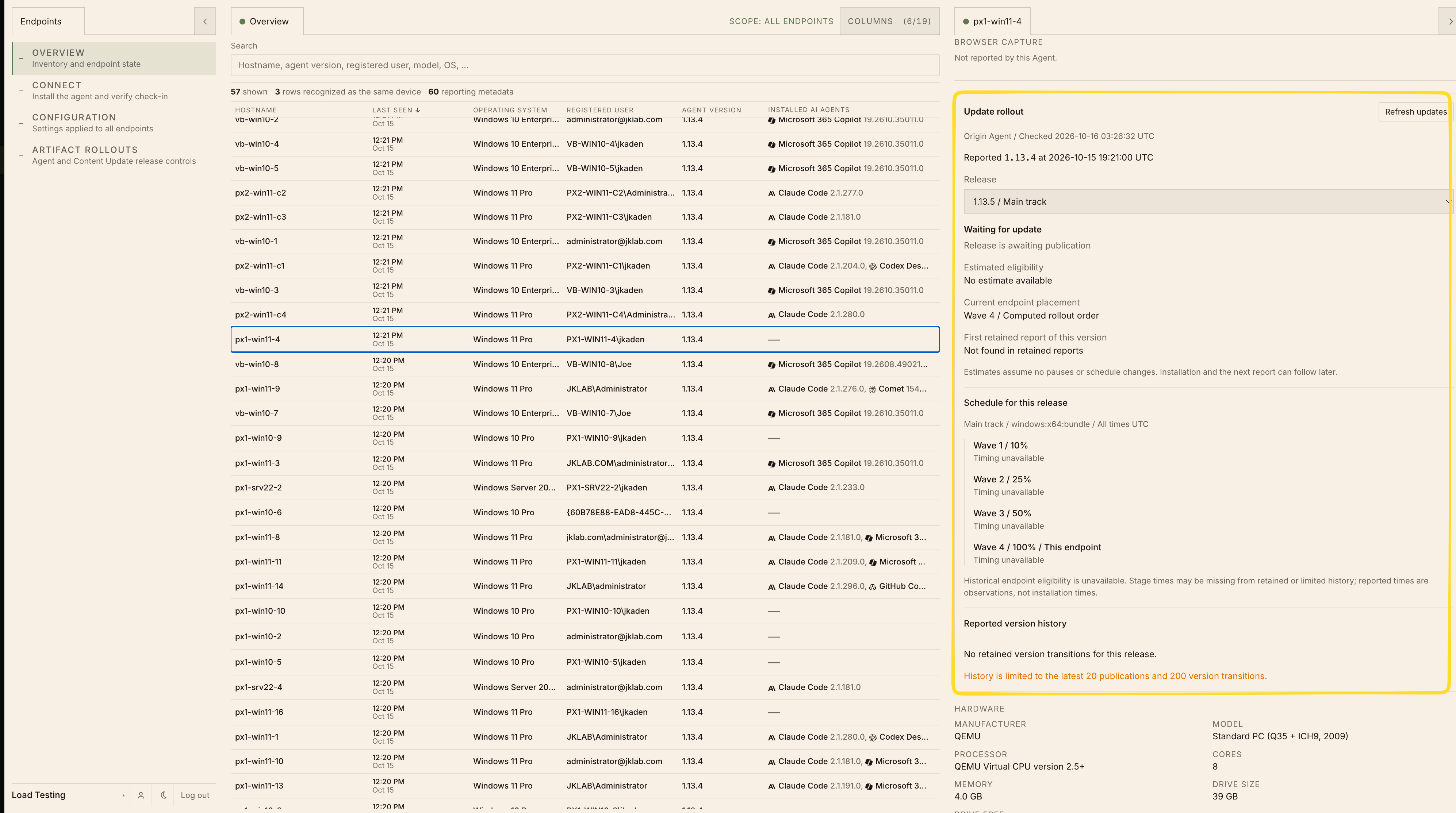 The card shows:
| Field | What it means |
| - | - |
| **Checked / Reported** | When rollout state was last checked, and the agent version the endpoint last reported |
| **Release** | The release and track you are viewing (for example `1.13.2 / Main track`) |
| **Version reported** | Whether the endpoint already reports this version |
| **Estimated eligibility** | When the endpoint becomes eligible for the release |
| **Current endpoint placement** | The wave the endpoint falls in, and whether that comes from the computed rollout order or an override |
| **First retained report of this version** | When the endpoint first reported the version |
| **Schedule for this release** | Each wave, its percentage, when it opened, and which wave includes this endpoint |
| **Reported version history** | Version transitions the endpoint has reported (for example `1.13.1 to 1.13.2`) |
Click **Refresh updates** to re-check the endpoint's rollout state.
Estimates assume no pauses or schedule changes. Reported times are observations, not installation times, and installation plus the next report can follow later. History is limited to the latest 20 publications and 200 version transitions.
This documentation is built and hosted on [Mintlify](https://mintlify.com), a developer documentation platform.
The card shows:
| Field | What it means |
| - | - |
| **Checked / Reported** | When rollout state was last checked, and the agent version the endpoint last reported |
| **Release** | The release and track you are viewing (for example `1.13.2 / Main track`) |
| **Version reported** | Whether the endpoint already reports this version |
| **Estimated eligibility** | When the endpoint becomes eligible for the release |
| **Current endpoint placement** | The wave the endpoint falls in, and whether that comes from the computed rollout order or an override |
| **First retained report of this version** | When the endpoint first reported the version |
| **Schedule for this release** | Each wave, its percentage, when it opened, and which wave includes this endpoint |
| **Reported version history** | Version transitions the endpoint has reported (for example `1.13.1 to 1.13.2`) |
Click **Refresh updates** to re-check the endpoint's rollout state.
Estimates assume no pauses or schedule changes. Reported times are observations, not installation times, and installation plus the next report can follow later. History is limited to the latest 20 publications and 200 version transitions.
This documentation is built and hosted on [Mintlify](https://mintlify.com), a developer documentation platform.